

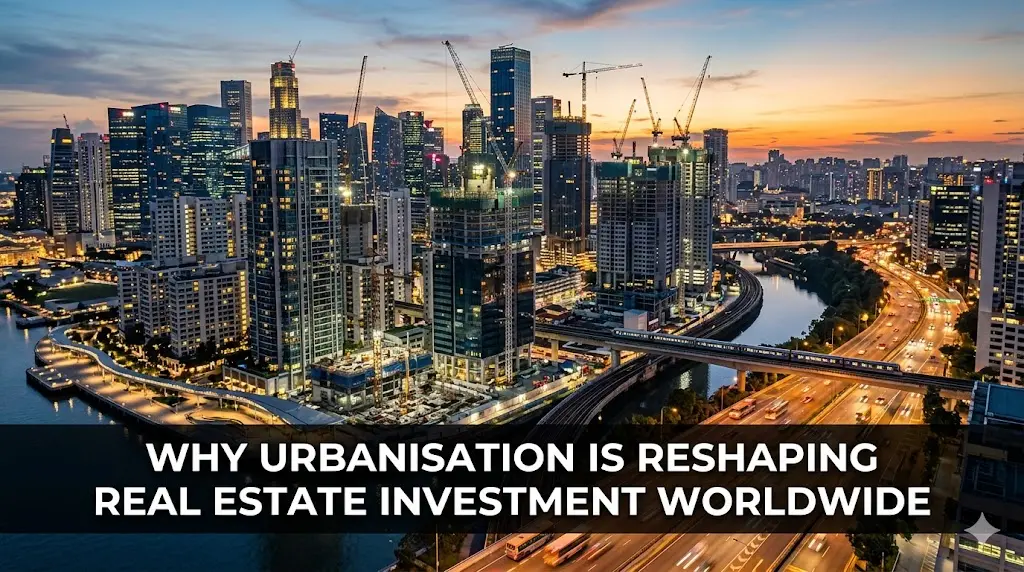
Urbanisation is changing how people live, work, and invest. As more people move into cities, real estate investment is shifting toward mixed-use developments, smart housing, rental demand, and infrastructure-led growth. Investors who understand these changes early are usually the ones who benefit the most.
Urbanisation is reshaping global real estate investment because cities are expanding faster than infrastructure can keep up. That creates demand for housing, commercial space, logistics hubs, and smart urban projects. Investors now focus less on traditional property ownership and more on long-term urban growth trends.
What Is Urbanisation and Why Does It Matter?
Urbanisation: the process where more people move from rural areas into towns and cities, increasing urban population density and economic activity.
Here's the thing. Urbanisation isn't just about crowded cities or taller buildings. It affects jobs, transportation, lifestyle habits, consumer spending, and eventually where money flows in the property market.
I've seen investors treat urbanisation like a background statistic when it's actually one of the biggest forces shaping global real estate investment. When a city grows rapidly, everything around it changes. Retail follows population. Businesses follow talent. Housing demand rises almost overnight.
In most cases, real estate markets don't move randomly. They move where people move.
Over the last decade, cities across Asia, Africa, Europe, and parts of Latin America have experienced aggressive urban expansion. According to population projections published by the United Nations, nearly 70% of the world's population may live in urban areas by 2050. That single trend is pushing governments and investors to rethink how cities are built and financed.
What most people overlook is that urbanisation creates opportunities beyond luxury apartments. Warehouses, co-living spaces, transit-oriented housing, suburban retail zones, and affordable rental properties are all benefiting from this shift.
Why Urbanisation Matters in 2026
Urbanisation in 2026 looks very different from what we saw even five years ago.
Remote work changed city dynamics. Rising migration reshaped rental demand. Infrastructure spending exploded in developing economies. At the same time, younger buyers are delaying home ownership and choosing flexible urban living instead.
That combination is transforming worldwide property investment trends faster than many analysts expected.
One surprising shift is this: smaller satellite cities are becoming investment hotspots. Years ago, investors focused only on major financial capitals. Now, secondary urban centers are attracting attention because prices are lower while population growth remains strong.
Take a realistic example. Imagine a mid-sized city connected to a major metro through a new high-speed rail project. Property values near transport hubs often rise before the infrastructure is fully operational. Investors who move early usually gain the advantage.
In my experience, transport infrastructure often predicts profitable real estate zones better than flashy marketing campaigns do.
Another major factor in 2026 is affordability pressure. Housing prices in established urban cores have pushed residents toward surrounding districts. That creates ripple effects in suburban commercial real estate, rental housing, and mixed-use developments.
A report from the World Bank has repeatedly highlighted how urban expansion influences economic productivity and land value growth. Cities that improve infrastructure and housing supply generally attract stronger long-term investment activity.
Expert Tip
Investors shouldn't just track population growth. Watch transportation projects, zoning policy changes, and migration patterns. Those three indicators often reveal where urban real estate demand will rise next.
How Urbanisation Is Reshaping Real Estate Investment Worldwide
Urban growth affects nearly every category of property investment. Some sectors benefit immediately while others evolve gradually.
1. Rental Housing Is Becoming More Valuable
As cities become more expensive, many people rent longer instead of buying homes early.
That increases demand for:
Multi-family apartments
Co-living developments
Build-to-rent communities
Affordable urban housing
Institutional investors are paying attention because rental income tends to remain stable in densely populated urban zones.
Frankly, younger professionals care more about location flexibility than ownership prestige in many cities now.
2. Commercial Real Estate Is Evolving
Office demand hasn't disappeared. It has changed.
Modern urban businesses want flexible workspaces, energy-efficient buildings, and locations close to transportation networks. Older office towers without upgrades may struggle, while mixed-use urban projects continue attracting tenants.
What most guides miss is that restaurants, clinics, gyms, and coworking spaces now influence residential property value more than luxury finishes in some markets.
People want convenience. Developers are building around that reality.
3. Logistics and Warehousing Are Booming
Urbanisation also fuels e-commerce growth. More consumers in cities means faster delivery expectations.
That creates huge demand for:
Last-mile delivery hubs
Urban warehouses
Industrial logistics parks
This sector quietly became one of the strongest performers in global real estate investment.
And honestly, many traditional investors ignored it for years because warehouses weren't considered glamorous assets.
4. Infrastructure-Led Investments Are Rising
Governments are investing heavily in:
Metro systems
Airports
Smart city projects
Highways
Public transport corridors
Real estate surrounding infrastructure projects often experiences rapid appreciation.
I've personally watched overlooked neighborhoods become investment hotspots simply because a transit expansion was announced.
Timing matters a lot here.
How to Invest in Urbanisation Trends Step by Step
Urbanisation creates opportunity, but random buying rarely works. Investors need a structured approach.
Step 1: Identify Fast-Growing Urban Regions
Start by researching cities with:
Population growth
Job creation
Infrastructure expansion
Strong migration inflows
Emerging urban corridors usually offer better upside than saturated luxury districts.
Step 2: Study Infrastructure Development
New transit systems and public projects often predict future demand.
Look for:
Rail expansion
Airport upgrades
Smart city initiatives
Industrial development zones
This step alone filters out many weak investments.
Step 3: Focus on Demand, Not Hype
Some properties trend online but lack real occupancy demand.
Pay attention to:
Rental yields
Vacancy rates
Local income growth
Commercial activity
Here's where many investors get burned. They buy based on appearance instead of long-term utility.
Step 4: Diversify Property Types
Urbanisation doesn't affect every sector equally.
A balanced investor might combine:
Residential rentals
Logistics assets
Retail spaces
Mixed-use developments
Different sectors respond differently during economic shifts.
Step 5: Think Long Term
Urban transformation usually unfolds over years, not months.
Short-term speculation can work occasionally, but sustained urban growth often rewards patient investors more consistently.
Expert Tip
Avoid investing solely in already-famous districts. In many cases, surrounding growth corridors offer stronger appreciation potential with lower entry costs.
The Biggest Misconception About Urban Real Estate
Bigger Cities Don't Always Mean Better Returns
This might sound counterintuitive, but massive cities aren't automatically the best investment choice anymore.
High entry prices can reduce returns significantly.
Secondary cities with improving infrastructure sometimes outperform major urban centers because:
Land remains affordable
Population growth is accelerating
Governments actively support development
Businesses relocate for lower costs
I've seen investors become obsessed with globally famous cities while completely ignoring nearby regions quietly producing stronger rental yields.
That obsession with prestige can hurt returns.
What Actually Works in Modern Urban Property Investment
Let me be direct. Chasing trends without understanding urban behavior rarely works long term.
The investors doing well right now usually focus on practical human needs:
Housing near transit
Walkable neighborhoods
Affordable rentals
Flexible commercial space
Digital infrastructure access
A few years ago, I spoke with a property investor who kept buying luxury units in oversupplied areas because they "looked premium." Vacancy rates climbed, rental demand weakened, and returns stalled.
Meanwhile, smaller apartments near transportation hubs stayed occupied consistently.
That tells you a lot about where urban demand is heading.
Another hot take? Fancy architecture doesn't guarantee profitable real estate investment. Accessibility often matters more than appearance.
And honestly, that's probably not changing anytime soon.
Expert Tip
If you're evaluating an urban property, spend time in the neighborhood physically if possible. Watch foot traffic, public transport usage, and nearby business activity. Data helps, but street-level observation reveals details reports sometimes miss.
How Technology Is Influencing Urban Real Estate
Urbanisation and technology now work together.
Smart buildings, digital infrastructure, and AI-driven city planning are changing investment priorities worldwide.
Developers increasingly integrate:
Energy-efficient systems
Smart security
Automated building management
Shared mobility infrastructure
Tenants notice these features more than many investors assume.
In competitive urban markets, buildings without modern systems may lose attractiveness faster than expected.
Interestingly, sustainability has shifted from a marketing feature into a financial consideration. Lower energy costs and regulatory compliance increasingly affect long-term property value.
Cities pushing green building regulations are already influencing investment decisions globally.
People Most Asked About Urbanisation and Real Estate
How does urbanisation affect property prices?
Urbanisation usually increases property prices because demand for housing and commercial space rises as populations grow. However, pricing depends heavily on infrastructure, employment opportunities, and housing supply.
Is urban real estate still a good investment in 2026?
In many regions, yes. Urban real estate investment remains attractive because cities continue driving economic growth. Still, investors need to focus on affordability, infrastructure, and long-term demand instead of speculation alone.
Which property sectors benefit most from urbanisation?
Residential rentals, logistics facilities, mixed-use developments, and transit-oriented commercial properties often benefit the most. Demand tends to follow population movement and urban convenience.
Why are secondary cities becoming popular with investors?
Secondary cities often offer lower entry prices, improving infrastructure, and faster population growth. Investors may achieve stronger rental yields and appreciation compared to expensive primary urban centers.
Does remote work reduce urban property demand?
Not entirely. Remote work changed office usage patterns, but cities still attract businesses, talent, education, healthcare, and entertainment industries. Urban demand is evolving rather than disappearing.
What are the risks of investing in rapidly growing cities?
Risks include oversupply, poor infrastructure planning, regulatory changes, and affordability pressure. Investors should evaluate local economic fundamentals carefully before committing capital.
How does infrastructure influence real estate investment?
Infrastructure improves accessibility, business activity, and housing demand. Areas connected to transportation projects often experience increased property values over time.
Final Thoughts
Urbanisation is reshaping real estate investment worldwide because cities remain the center of economic activity, innovation, and population growth. Investors who understand migration trends, infrastructure expansion, and changing lifestyle preferences are better positioned to identify long-term opportunities.
What matters now isn't simply owning property. It's understanding how people want to live inside modern cities.
That shift changes everything.
Boost your brand visibility and organic traffic with trusted press release distribution services and expert digital marketing services designed for businesses, agencies, and startups seeking high authority backlinks, media coverage, instant publishing, and stronger SEO ranking. Whether you're scaling a local campaign or expanding globally, these solutions help drive targeted exposure and long-term online growth through reliable PR distribution services and performance-focused SEO strategies.