

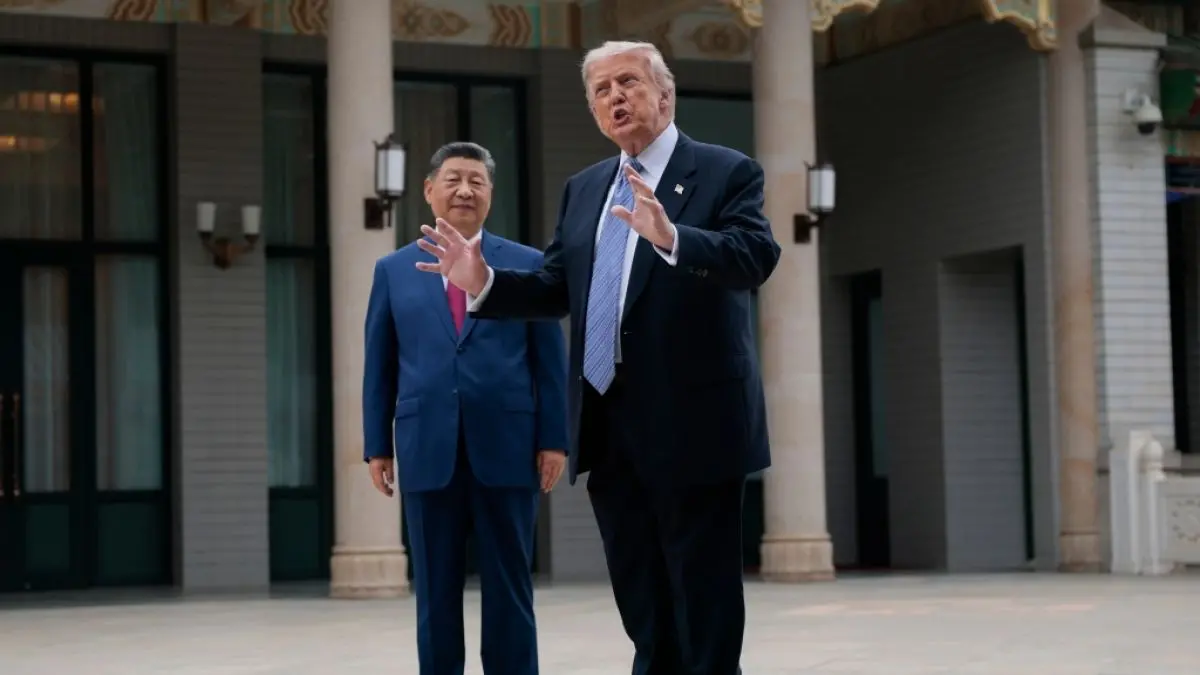
U.S. President Donald Trump has once again captured global attention with a string of controversial remarks about a foreign leader. During an interview with Fox News host Sean Hannity broadcast on Thursday evening, Trump offered unusually effusive praise for Chinese President Xi Jinping, describing him as "like out of a picture book" for a Chinese leader. The comments, which included observations about Xi's physical appearance and leadership style, have sparked intense debate on social media and drawn accusations of racism.
Trump stated, "If you went to Hollywood and looked for a leader of China to play a role in a movie, he's central casting. You couldn't find a guy like him." The term "central casting" refers to a long-standing Hollywood agency that provides extras for films, but in modern usage it implies someone who perfectly fits a stereotypical role. Trump's use of the phrase for Xi Jinping, combined with a remark about his height, has been interpreted by many as reinforcing racial stereotypes about Asian people.
The president continued, "He is tall, very tall, and especially for this country, because they tend to be somewhat smaller." This comment, while intended as praise, immediately drew sharp criticism. On the platform X (formerly Twitter), users were quick to condemn the statement. One wrote, "Make racist comments great again. Every damn day." Another user expressed disbelief: "His stupidity is breathtaking. How the hell did we end up here?" Several commenters noted Trump's recent pattern of focusing on male bodies, with one saying, "Trump has been talking a lot about men's bodies lately. Just saying."
Beyond the physical description, Trump also praised Xi's leadership qualities. "I think he's actually a warm-hearted person, but he's entirely focused on business. No games," Trump said. "With Xi, there's no small talk about the weather or the stars — only substance." Trump acknowledged that such positive comments about certain leaders often attract criticism. "They always criticize me when I say good things about certain leaders," he remarked. "But Xi leads nearly 1.5 billion people and he commands respect. What am I supposed to do?"
Context of the Remarks
Trump's interview with Hannity came during a period of heightened tension between the United States and China. Trade disputes, technology competition, and geopolitical rivalries have defined the relationship in recent years. Trump, who has positioned himself as a tough negotiator with Beijing, has frequently oscillated between confrontation and admiration when discussing Xi Jinping. In past meetings, Trump has referred to Xi as a "great leader" and praised his handling of North Korea, while simultaneously imposing tariffs and criticizing China's human rights record.
The latest comments appear to be part of Trump's broader tendency to evaluate world leaders through a personal lens. Known for focusing on physical attributes and charisma, Trump has previously praised Egyptian President Abdel Fattah el-Sisi as a "fantastic guy" and described North Korean leader Kim Jong Un as "short and fat" but also "a very smart guy." His remarks about Xi Jinping follow a similar pattern: a mix of admiration and condescension that often leaves observers puzzled about his true intentions.
Social media reactions also highlighted the perceived absurdity of the interview. One user joked, "I feel sorry for anyone who has to interview Trump and keep a straight face while he rambles on." Another pointed out the racial undertones: "Trump basically said Xi looks the part of a Chinese leader, as if there's a single type. That's textbook racism."
Historical Parallels and Analysis
Trump's use of the phrase "central casting" is particularly telling. The term originated with a Hollywood agency founded in 1925 that provided extras and bit players. Over time, it evolved into a metaphor for someone who perfectly fits a stereotypical role, often based on physical appearance or ethnicity. For Trump, a former reality television star and businessman, Hollywood metaphors come naturally. He has often described political situations in cinematic terms, such as calling the Mueller investigation a "witch hunt" or comparing his own legal battles to a movie plot.
Critics argue that by characterizing Xi Jinping as "straight out of a picture book" for a Chinese leader, Trump reinforces a narrow, essentialist view of what a Chinese person should look like. This echoes broader concerns about the president's history of racially charged statements, including his comments about Mexican immigrants being criminals and his defense of the Central Park Five. The Xi remarks, while ostensibly positive, have been interpreted as a form of benevolent stereotyping that still reduces an individual to a group characteristic.
Some commentators noted that Trump's focus on Xi's height is particularly puzzling. Xi is reported to be around 5 feet 10 inches tall (about 178 cm), which is slightly above average for a Chinese male but hardly exceptional. In the United States, Trump himself stands 6 feet 3 inches (190 cm) tall and has a well-documented fascination with stature. He has famously mocked opponents like Jeb Bush for being "low energy" and claimed his own hands are "very large." The emphasis on Xi's height suggests Trump views physical size as a marker of strength and capability.
The Chinese government has not officially responded to Trump's latest comments. However, state media outlets have often been cautious about covering Trump's more personal remarks, focusing instead on bilateral agreements or diplomatic meetings. In previous instances, when Trump made similar comments about Xi's appearance — such as during a 2018 meeting when Trump said Xi is "a great gentleman" — Chinese media either ignored the remarks or framed them as a sign of mutual respect. This time, the overtly racial tone may provoke a different reaction.
Deng Xiaoping, the former Chinese leader known for his pragmatic approach to economic reform, once famously said, "It doesn't matter if a cat is black or white, as long as it catches mice." Trump's praise for Xi similarly focuses on results rather than ideology. The U.S. president appreciates that Xi is "entirely focused on business" and does not engage in what Trump considers frivolous conversation. This aligns with Trump's transactional view of international relations, where personal chemistry and deal-making prowess often outweigh policy differences.
However, Trump's comments also raise questions about his understanding of China's political system. Xi Jinping is not merely a businessman; he is the paramount leader of the Chinese Communist Party, overseeing a vast bureaucratic apparatus with strict ideological controls. To describe him as "warm-hearted" but strictly business may miss the broader context of his policies, including the suppression of dissent, the expansion of surveillance, and the crackdown in Xinjiang. Critics argue that Trump's personal admiration for Xi blinds him to the human rights abuses carried out under Xi's leadership.
The controversy surrounding the interview comes at a time when Trump's own health and mental fitness are under scrutiny. Several recent articles have questioned whether the president is physically and mentally capable of leading the country, with doctors and observers noting unusual behavior and difficulty staying awake during meetings. In this context, Trump's rambling praise for Xi — including a tangent about Hollywood casting — may feed into narratives about his cognitive decline. Yet, as with many Trump incidents, the news cycle quickly moved on to other topics, with no lasting policy impact.
As the debate continues on social media, one thing is clear: Trump's ability to dominate headlines with a few offhand remarks remains undiminished. Whether intentional or not, his comments about Xi Jinping have once again placed the U.S.-China relationship in the spotlight, albeit for reasons that have little to do with diplomacy and much to do with the president's idiosyncratic personality.
Source: News.de News