

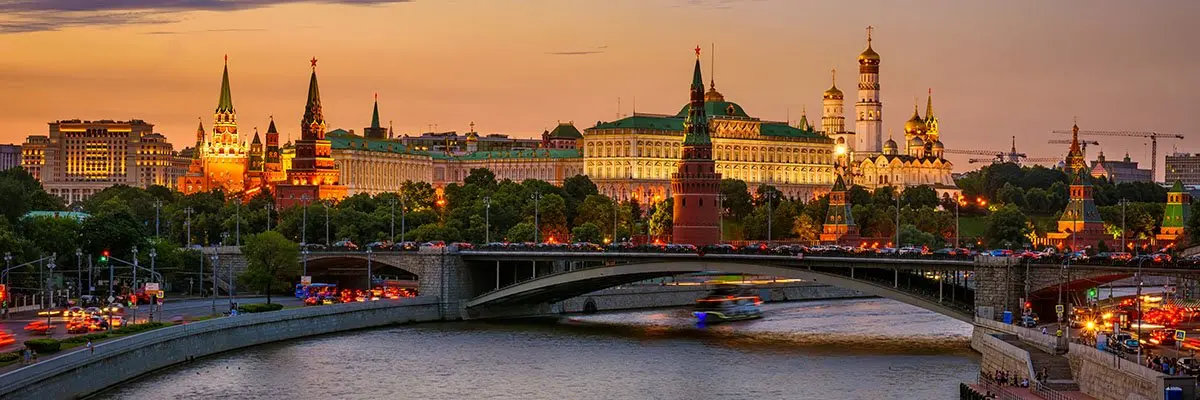
In Moscow, artificial intelligence (AI) has transcended its science fiction origins to become the backbone of urban management, provided the city retains sovereignty over its technology capabilities. Speaking at a fireside chat at Gitex AI Asia 2026 in Singapore, Sergey Cheremin, minister of the government of Moscow and head of the department for external economic and international relations, outlined the Russian capital's use of AI across public services, while cautioning against over-reliance on foreign technology vendors.
Managing a metropolis of 15 million people with a gross domestic product (GDP) exceeding $450 billion demands an efficient digital ecosystem, Cheremin noted. Today, the city implements AI in more than 130 programs, spanning traffic control, healthcare, education, waste management and construction. "AI for us is not science fiction or about The Matrix," he told the audience, referring to the 1999 movie that predicted a world dominated by AI. "It's really online management of all municipalities."
Digital Sovereignty as a Foundation
But as governments around the world race to build their computing capacities, Cheremin stressed that true security will only come from having true digital sovereignty. "For big megacities like Moscow, it's very important to provide security for your infrastructure, and you cannot be dependent on a few companies or technical solutions," he said. "You cannot allow the vendors to dictate how you are going to manage the city."
To mitigate these risks and protect against cyber attacks that could trigger catastrophic electricity blackouts or system failures, Cheremin said all strategic and sensitive technologies for Moscow are developed in-house by expert IT teams. "It's not good to be isolated, but it's also important to be sovereign so you're not dependent on anyone," he added.
This approach to digital sovereignty aligns with broader trends among nations that seek to reduce reliance on foreign technology providers, particularly in critical infrastructure. For Moscow, the stakes are high given the city's role as the political, economic and cultural heart of Russia. By developing its own AI platforms and data-processing systems, Moscow aims to maintain control over citizen data, prevent unauthorized access, and ensure that urban management systems remain operational even during geopolitical disruptions.
The city's strategy also involves creating an ecosystem of local technology companies and research institutions that can contribute to the development of AI solutions tailored to Moscow's specific needs. This includes partnerships with universities and startups focused on machine learning, computer vision, and natural language processing. The result is a growing pool of homegrown talent that can sustain and evolve the city's digital infrastructure without external dependencies.
From Moscow to Singapore: Learning and Adapting
Noting the importance of international knowledge-sharing, Cheremin recalled his first trip to Singapore in 2010 to study the city-state's advanced intelligent transport management systems. Realizing that foreign systems could not be transplanted into another city wholesale, Moscow studied other models from New York, London, Paris and Barcelona, among other cities, and engaged companies such as Siemens, Cisco and Thales, eventually creating a traffic management system tailored to its needs.
Today, the city's transport system uses AI to optimize traffic flow, reducing congestion and saving commuters up to 30% of travel time. Furthermore, subway access is now processed through automatic biometric billing, removing the need for traditional transport cards. This system uses facial recognition to identify passengers as they pass through turnstiles, automatically charging their accounts. The technology has been integrated with the city's broader payment systems, allowing for seamless travel across different modes of public transportation.
Moscow's transport AI also extends to predictive maintenance of trains and infrastructure. Sensors on subway cars and tracks collect data on vibration, temperature, and wear, which is analyzed by machine learning algorithms to predict potential failures before they occur. This has reduced service disruptions and extended the lifespan of equipment, saving the city millions of rubles annually.
Security, Healthcare, and Urban Planning
Moscow has also deployed a massive security network of more than 260,000 CCTV cameras integrated into a single data-processing system. According to the minister, this has slashed the city's crime rate by 90% over the past decade and reduced car thefts by 15 times. The cameras use AI-powered facial recognition and object detection to identify suspicious activities in real time. The system can automatically alert law enforcement to incidents such as unattended bags, fights, or vehicles moving in restricted areas.
Beyond security and transport, AI has delivered economic and social returns for the city. In healthcare, AI-assisted radiology can identify diseases and predict cancers with high accuracy, saving both time and money for Moscow's healthcare system. The city's hospitals have deployed AI algorithms that analyze X-rays, CT scans, and MRI images to detect early signs of lung cancer, breast cancer, and cardiovascular conditions. These tools have reduced diagnostic errors and allowed doctors to focus on treatment planning rather than initial screening.
In urban planning, Moscow has spent a decade building a digital twin, a virtual model of the city featuring more than 9,000 data layers, from underground infrastructure such as subway lines and utility pipes to district demographics and traffic patterns. Planners can use this digital twin to simulate the impact of future construction projects on traffic flow, air quality, energy consumption, and population density. The model is updated in real time with data from thousands of sensors deployed across the city, providing a living representation of Moscow's urban environment.
The digital twin has been instrumental in major infrastructure projects, such as the expansion of the Moscow Metro and the redevelopment of industrial zones into residential districts. By running simulations before breaking ground, the city has avoided costly mistakes and minimized disruptions to residents. The system also helps emergency services plan evacuation routes and resource allocation during natural disasters or large-scale events.
Waste management is another area where AI has made a significant impact. Moscow's smart waste bins are equipped with sensors that monitor fill levels and optimize collection routes. This has reduced fuel consumption by collection trucks by 25% and decreased the number of bins overflowing on streets. The system also uses AI to sort recyclables at processing facilities, improving recycling rates and reducing landfill usage.
In education, AI-powered platforms personalize learning for students in Moscow's schools. Adaptive software assesses each student's strengths and weaknesses and adjusts lesson plans accordingly. Teachers can use dashboards to track class performance and identify students who need extra help. Early results show improved test scores and higher student engagement, particularly in mathematics and science subjects.
Global Partnerships and Tech Diplomacy
Despite his strong advocacy for digital sovereignty, Cheremin reiterated that Moscow is not turning its back on the global tech community. He pointed to city-to-city diplomacy, noting that Moscow actively shares its technological playbook with cities across Southeast Asia, China, India, Africa and Latin America. "We understand that the situation is difficult...and it becomes unpredictable sometimes," he said, referencing global geopolitical tensions that make events such as Gitex vital for sharing technological experience.
"We are really proud for several decades that we have a very good partnership with Singapore," Cheremin said. With 80% of the world's population expected to live in cities within two decades, he added, Moscow will continue to strengthen its partnerships with ASEAN and Chinese cities such as Beijing, Shanghai and Chengdu to build a stable urban platform.
These partnerships often take the form of knowledge exchange programs, joint research projects, and technology transfers. For example, Moscow has collaborated with Singapore's Land Transport Authority to refine its traffic management algorithms. Similarly, the city has shared its digital twin framework with officials from Shenzhen and Mumbai, helping them develop their own urban planning tools. In return, Moscow has adopted best practices from partner cities in areas such as water management and green building standards.
The city's international engagement also extends to multilateral forums like the United Nations' Smart Cities initiatives and the World Economic Forum's G20 Global Smart Cities Alliance. Moscow has contributed to the development of international standards for AI ethics and data governance, advocating for approaches that balance innovation with citizen privacy and security.
Cheremin's appearance at Gitex AI Asia 2026, held in Singapore, underscores Moscow's commitment to maintaining open channels in a fragmented global tech landscape. Despite sanctions and geopolitical tensions, Moscow continues to participate in major technology conferences, where it showcases its AI achievements and seeks solutions to common urban challenges. The minister noted that cities often face similar problems regardless of national politics, and that sharing experience is the fastest path to progress.
As AI becomes more deeply embedded in the fabric of urban life, Moscow's model offers both a warning and an inspiration. The warning is clear: over-reliance on a small number of foreign technology vendors creates vulnerabilities that can be exploited in times of conflict. The inspiration is that with sustained investment in local talent and infrastructure, cities can achieve both technological sophistication and strategic autonomy. For Moscow, the journey toward digital sovereignty is not a retreat from the world but a reinvention of how a city engages with it.
Source: ComputerWeekly.com News