

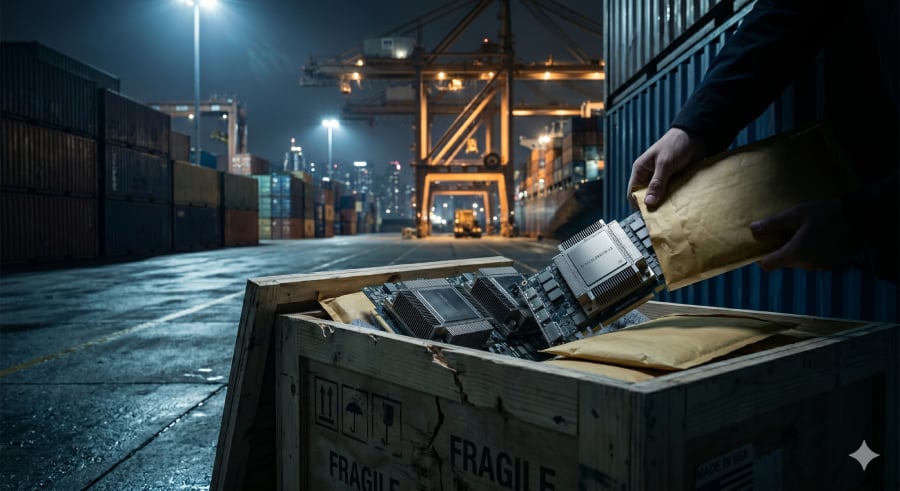
The United States has implemented stringent export controls to prevent its most advanced AI chips from reaching rival powers, particularly China and Russia. Yet recent court cases and enforcement actions reveal that these restrictions are being systematically bypassed through a network of shell companies, encrypted communications, and third-country intermediaries. A Fortune report highlights how brokers are rerouting shipments through go-between countries, allowing high-end semiconductors from the US to quietly evade restrictions. Officials express concern that these chips are supporting military AI systems used by Russia in the Ukraine war, surveillance infrastructure, cyber operations, and broader geopolitical competition.
How Restricted AI Chips Allegedly Reached China
Court filings from a recent case center on Matthew Kelly, Stanley Yi Zheng, and Tommy Shad English, who prosecutors allege discussed moving banned Nvidia GPUs to China via front companies. Encrypted messages show Zheng cautioning Kelly against explicitly mentioning China in their texts, warning that it could draw US government attention to potential embargo violations. These conversations form part of a wider network tied to smuggling and export-control violations, though formal charges against the trio are pending a June decision.
This case is just one example of mounting enforcement pressure from the Bureau of Industry and Security (BIS). Over the past year, the BIS has expanded its crackdowns on export-control violations, announcing nearly $420 million in combined penalties and forfeitures related to technology smuggling. Among the most prominent actions was a $252 million penalty against Applied Materials for routing semiconductor equipment to China using a Korean subsidiary. Cadence Design Systems also pleaded guilty and agreed to pay $95 million in fines. Another notable case occurred in Florida, where Hon Ning “Matthew” Ho and Cham “Tony” Li, along with two others, used a sham company to smuggle 400 Nvidia A100 chips into China through Malaysia and Thailand. In the largest case to date, Supermicro cofounder Yih-Shyan “Wally” Liaw was arrested in March for masterminding a $2.5 billion shipment of servers to China via a shell company in Southeast Asia. Liaw pleaded not guilty, but investigations continue, with Supermicro receiving another subpoena from the SEC.
Must-read security coverage
- UK Police Convicts Pair in £5.5 Billion Bitcoin Launder Case
- Blackpoint Cyber vs. Arctic Wolf: Which MDR Solution is Right for You?
- How GitHub Is Securing the Software Supply Chain
- 8 Best Enterprise Password Managers
Why Advanced Chips Are a Security Concern
According to a Ukrainian analysis cited by the US Senate, 72% of 2,797 foreign components found in Russian weapons had US origins. Highly lethal weapons like the Kh-101 missiles were among those noted in the analysis. Beyond Russia, US export controls are also shaped by concerns over China, where access to advanced chips has become a strategic issue. Although the US has permitted some Nvidia chips into China, including its H200 recently, restricted technology has consistently flowed into China through black-market channels.
In China, these chips are used for military research, AI infrastructure, and routine products. The US has consistently stated it does not want its technology used in Chinese military operations. As Greg Thomas, chief executive of ChainSentry, noted, “Semiconductors are the building blocks of global power in the 21st century. When an adversary or a competitor faces us on a battlefield or on the other side of a market, they need to bring their own game, not ours.” China, however, has consistently opposed the US practice of overstretching the concept of national security and export control, arguing that such conduct violates market economic laws and principles of fair competition.
Why Export Controls Remain Hard to Enforce
The investigations and BIS crackdowns indicate a broader enforcement dilemma: the global appetite for advanced US technology has sustained diversion networks that remain difficult to fully disrupt. The cases also suggest Washington’s export-control strategy is entering a harder phase. Restricting advanced AI chips is one challenge; tracking them through shell companies, subsidiaries, brokers, and third-country routes is another. For now, the question is whether those rules can keep pace with a global market where the most restricted chips are also among the most valuable.
Also read: Apple and Intel reportedly reached an early chip manufacturing agreement that could reshape Apple’s supply chain and boost Intel’s foundry ambitions.
The history of US export controls on semiconductors dates back to the Cold War, when the Coordinating Committee for Multilateral Export Controls (CoCom) restricted technology transfers to the Soviet bloc. After the Cold War, the Wassenaar Arrangement emerged, but it was less restrictive. In recent years, the US has focused on China due to its rapid technological advancements and military modernization. The current controls target advanced AI chips like Nvidia’s A100 and H100, which are essential for training large-scale AI models used in facial recognition, autonomous systems, and surveillance. These chips also power high-performance computing for scientific research and defense applications.
The economic incentives for smuggling are enormous. Nvidia’s AI chips are in high demand globally, and China’s AI industry is eager to access them despite restrictions. Smugglers can charge a premium, making the black market highly profitable. The BIS has tried to close loopholes by tightening export license requirements and increasing penalties, but the complexity of global supply chains makes enforcement challenging. Intermediaries in countries like Malaysia, Thailand, Singapore, and Hong Kong serve as transshipment points. Shell companies are set up to obscure the final destination, and payments are often routed through multiple jurisdictions.
Encrypted messaging apps like WhatsApp and Signal are used to coordinate shipments, and legal documents are falsified. In some cases, brokers have been known to use cryptocurrency to avoid bank scrutiny. The US Department of Justice has stepped up prosecutions, but the volume of trade makes it difficult to catch every violation. Industry experts argue that the US needs to work more closely with allies to harmonize export controls and share intelligence on smuggling networks. However, differing national interests and commercial pressures complicate such cooperation.
The impact of these smuggled chips extends beyond economic losses. They enable adversaries to develop advanced military capabilities, including AI-powered drones, surveillance systems, and cyber weapons. For example, Russian use of US components in Kh-101 missiles has been documented, linking smuggled electronics to attacks on civilian infrastructure in Ukraine. Similarly, China’s use of US chips in its military AI projects could erode the technological edge of the US military.
To combat this threat, the BIS has created a task force dedicated to export enforcement, and it is using data analytics to identify suspicious trade patterns. It has also imposed entity list sanctions on Chinese companies suspected of involvement in diversion. But the cat-and-mouse game continues. As one former BIS official said, “Every time we close a door, they find a window.” The recent cases show that windows remain open, and the stakes are only getting higher as AI becomes central to national security.
Source: TechRepublic News