

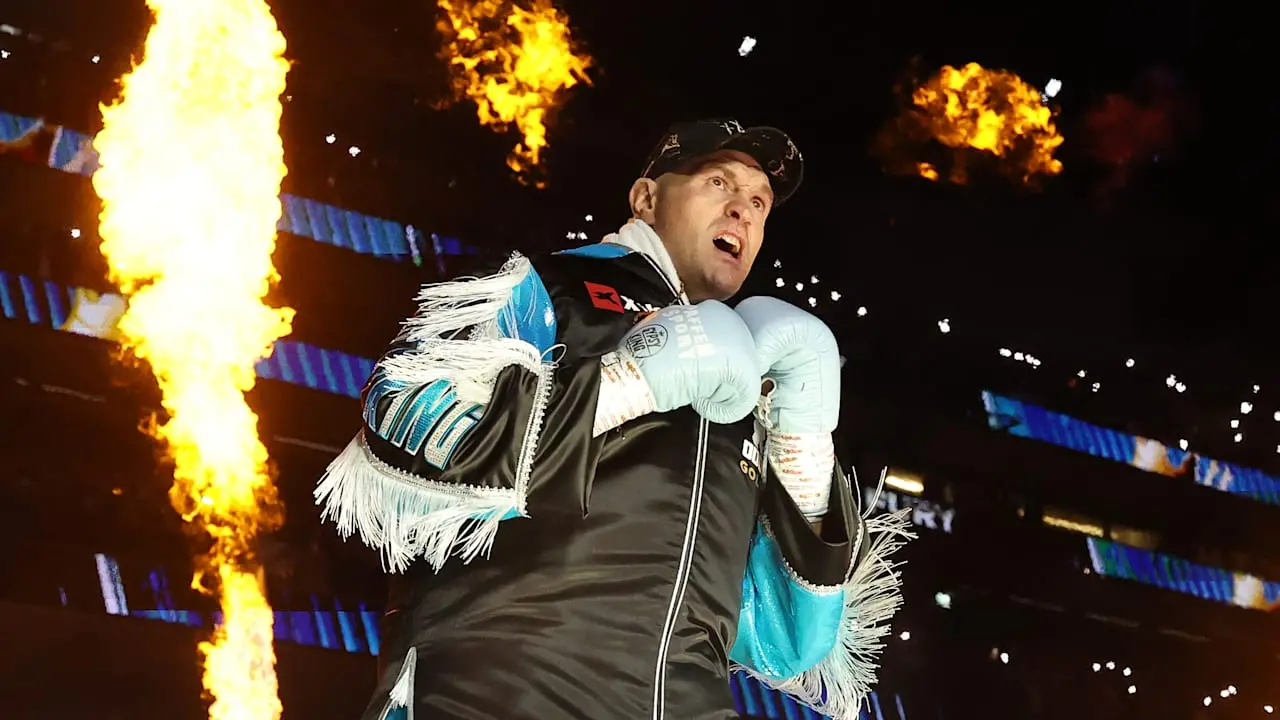
The world of boxing is set for a seismic shift as streaming giant Netflix announced it will broadcast the mega-fight between British heavyweights Tyson Fury and Anthony Joshua live to its entire global subscriber base of over 300 million people—with no extra pay-per-view charge. This unprecedented move, fueled by Saudi Arabian investment, marks a historic moment for both the sport and the streaming industry.
According to promoter Eddie Hearn, the bout is expected to take place in October or November, with London's iconic Wembley Stadium the frontrunner to host the event. However, alternative venues in the United States and Saudi Arabia remain under consideration. The fight has been years in the making, driven by an intense rivalry that has simmered since both fighters dominated the heavyweight division.
The Financial Revolution Behind the Fight
Netflix's decision to absorb the cost of the fight—typically hundreds of dollars per household—is made possible by Saudi financier Turki Alalshikh, who is bankrolling astronomical purses for both fighters. Industry insiders estimate Fury and Joshua will each earn well over $100 million, shattering previous pay records for a single bout. This signals a new era where deep-pocketed sovereign wealth funds bypass traditional broadcasters and use streaming platforms to reach a global audience instantly.
The move also positions Netflix as a serious contender in live sports broadcasting, following its recent forays into NFL games and WWE programming. For the 300 million subscribers, it is a windfall offering premium content without additional fees. The question remains how traditional cable and satellite providers will respond to this disruption.
Tyson Fury: The Gypsy King's Path to Redemption
At 37, Tyson Fury (34-2-1, 24 KOs) returns to the ring after a brief retirement. Following consecutive defeats to Oleksandr Usyk in 2024 and 2025—where he lost his WBC and lineal titles—Fury had announced he was stepping away. Yet the lure of a career-defining payday and a chance to silence his old rival brought him back.
In his comeback fight last month, Fury outpointed Arslanbek Makhmudov at the Tottenham Hotspur Stadium, proving he still possesses the agility and ring IQ that made him the lineal heavyweight champion. Fury is known for his unorthodox style, using reach and movement to frustrate opponents, combined with powerful straight punches. His biggest victories came against Wladimir Klitschko (2015) and Deontay Wilder (2020), the latter ending with a seventh-round TKO in a spectacular trilogy.
Fury has been characteristically loud in the build-up. "I will knock him out, guaranteed," he declared. "He can't survive against me. He has no chin, and I will hit it because I am faster and the better boxer." These words mark the escalation of a decade-long war of words between the two Britons.
Anthony Joshua: Rebuilding After Tragedy
Anthony Joshua (28-3, 25 KOs), 36, has not fought since his devastating knockout victory over Jake Paul in December 2025. The win, which came in the second round, was a statement that AJ still possesses the raw power that once made him one of the most feared punchers in the division. A scheduled return in February was shelved after Joshua was involved in a serious car accident that tragically killed a close friend.
"It's no secret I've taken time to gather myself and rebuild," Joshua said. "I'm looking forward to fighting and picking up where I left off." However, before facing Fury, Joshua must first get past Albanian-Kosovan brawler Kristian Prenga on July 25 in Riyadh. Prenga, a heavy underdog, will be a mandatory test of Joshua's preparation.
Joshua's career trajectory has been a rollercoaster. He rose to fame after winning Olympic gold in 2012 and unified titles by stopping Wladimir Klitschko in 2017. He lost his titles to Andy Ruiz Jr. in 2019 before winning them back in the rematch. But two losses to Oleksandr Usyk in 2021 and 2022 exposed vulnerabilities in his stamina and defensive game. Since then, Joshua has worked with new trainers to refine his boxing—culminating in the Paul victory.
Historical Context: A Fight Ten Years in the Making
Fury and Joshua have never shared a ring professionally, despite both dominating the heavyweight scene separately. Their rivalry has been fueled by social media jabs and press conference taunts dating back to 2014. For years, contractual disputes, mandatory obligations, and outside distractions prevented the big fight. Now, with both men in their mid-to-late 30s, it is a now-or-never moment.
The loser will likely face retirement or become a gatekeeper, while the winner stands to become the unified heavyweight champion—assuming the winner also faces the Usyk victor. But for now, the focus is purely on settling the score between the two Britons.
Styles Make Fights: What to Expect
Fury relies on his 6'9" frame, awkward head movement, and psychological warfare. He controls distance with a long jab and ties up opponents on the inside. Joshua, though slightly shorter at 6'6", is more compact and explosive, using vicious hooks and uppercuts. The key question is whether Joshua can close the distance without taking punches, and whether Fury can take Joshua's power.
If Fury uses his reach advantage and boxes on the back foot, he may outpoint Joshua. But if Joshua lands early, his power could change the fight. Early rounds will be critical for both. The fighter who imposes his will first could dominate.
Global Impact and Boxing's New Era
This fight represents the growing influence of Saudi Arabia in boxing, following events like the "Day of Reckoning" and the Fury-Usyk fights. Turki Alalshikh has emerged as the financial engine behind modern heavyweight boxing, and his relationship with Netflix could redefine how combat sports are distributed. The absence of pay-per-view costs removes a barrier that often limited viewership, potentially making this the most-watched boxing match in history.
Beyond the purse, the fight has implications for the sport's future. If successful, Netflix may acquire more rights to major fights, challenging ESPN, DAZN, and Sky Sports. Meanwhile, traditionalists worry about the "Saudi-fication" of boxing, where state resources overshadow sporting merit. Yet for now, fans are simply eager to see the two greatest British heavyweights of this generation finally collide with everything on the line.
Source: sportbild.bild.de News