

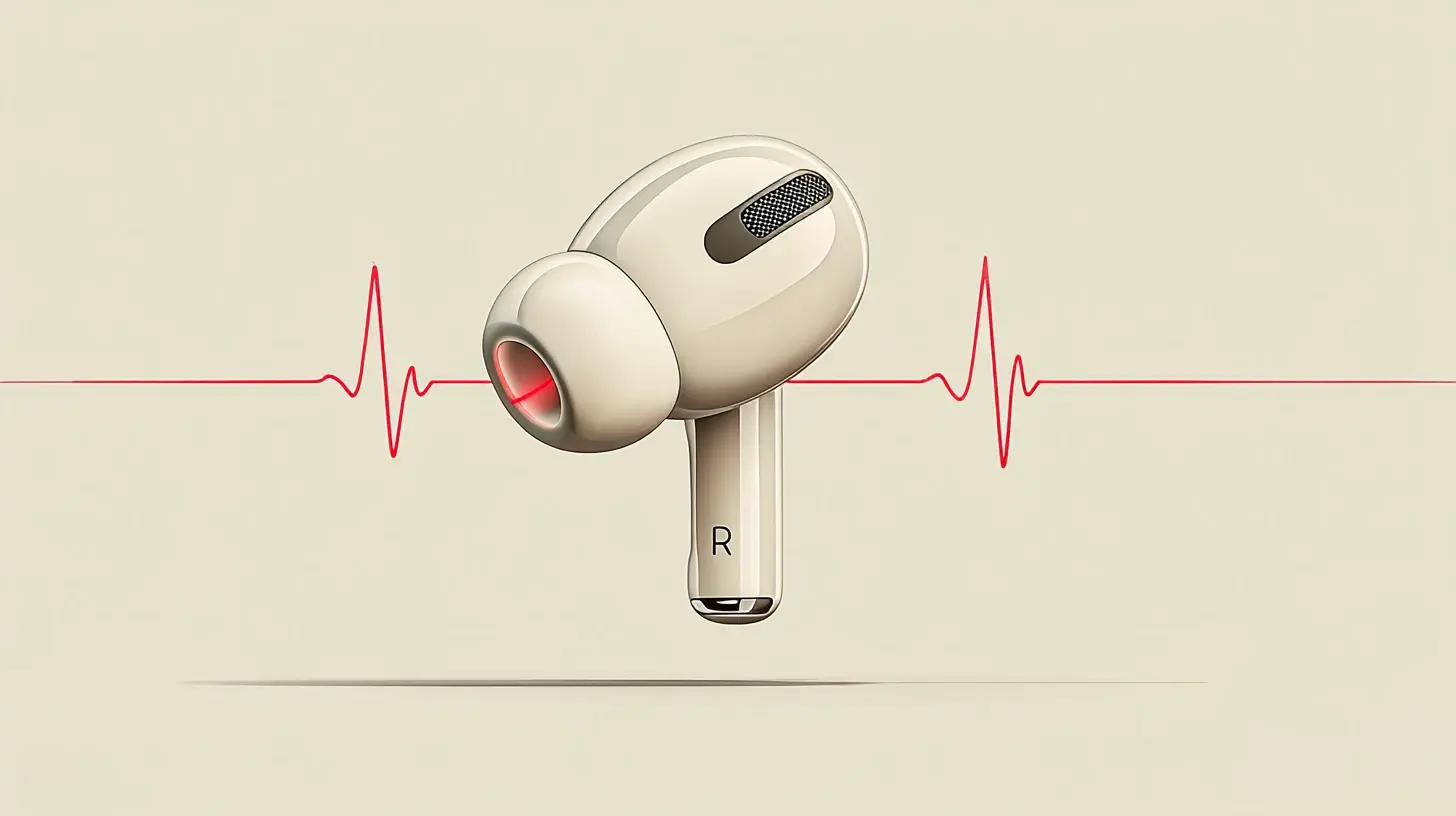
Continuous authentication has long been a goal for security researchers, aiming to eliminate the vulnerability of once-only biometric verification. A newly published study introduces AccLock, a system that turns standard wireless earbuds into passive biometric sensors by reading the subtle vibrations of a heartbeat from inside the ear canal. The method uses the accelerometer already present in many earbuds, requiring no additional hardware. The core idea is to repeatedly verify that the person wearing the device is the legitimate user, even after the initial unlock, providing a persistent layer of security.
How AccLock Works
Every heartbeat generates a small mechanical pulse that travels through the body. In the ear, that pulse manifests as a ballistocardiogram (BCG) signal, which an accelerometer can detect. AccLock processes the raw motion data by cleaning it, extracting features tied to the wearer's unique cardiac pattern, and comparing those features to a stored template. If the match meets a threshold, the session remains trusted; if it drifts, the system revokes access. Registration requires the user to sit still for about six minutes, though the researchers show that usable accuracy is achievable with as little as two minutes of enrollment data. Each authentication decision uses a four-second window of accelerometer data, with a sliding step that updates the trust state roughly every half second.
Reported Accuracy and Performance
The study involved 33 participants and tested the system under various conditions: sitting, lying down, light head movement, and even music playback at high volume. In these scenarios, the system maintained error rates in the low single digits—typically around 3% equal error rate. The performance was consistent across different age groups, genders, and even participants with common heart conditions such as bradycardia, tachycardia, coronary heart disease, and premature beats. The critical security test—what happens when the legitimate wearer removes the earbud and someone else picks it up—showed that AccLock detected the handoff within a few seconds in nearly all trials. This demonstrates the system’s core value for continuous authentication.
Limitations Under Movement and Speech
The system performed well for desk work and casual movement, but walking reduced accuracy noticeably, and running broke it almost completely. Talking also caused problems because jaw motion and shifting contact with the ear produce vibrations in the same frequency range as the heartbeat. The researchers found that including some talking samples during enrollment could recover part of the lost accuracy. Long-term drift poses another challenge: accuracy held steady for about six weeks but began to slip by week eight, likely due to gradual changes in fit, posture, and behavior. A background refresh routine using high-confidence samples helped keep the profile current, but the study only ran for two months, leaving open questions about reliability over longer periods. Additionally, a small subset of users consistently produced worse results, presumably due to anatomical differences affecting how the earbud sits in the ear.
The Hardware Constraint
The prototype used a custom 3D-printed earbud equipped with a standard commercial accelerometer sampling at 100 Hz. This sampling rate is critical because it captures the fine detail of the BCG signal. In contrast, consumer products like Apple AirPods expose only heavily downsampled motion data—around 25 Hz—to third-party developers. The team managed to run AccLock on AirPods by applying a lightweight retraining step, but error rates roughly doubled, from about 3% to around 7%. While still workable, this lower accuracy highlights the dependency on hardware vendors permitting access to raw sensor data if AccLock were to be deployed at scale.
Security and Threat Considerations
Most consumer biometrics—face, fingerprint, voice—are susceptible to spoofing attacks using printed photos, silicone replicas, or deepfake audio. A BCG signal offers greater spoof resistance because it originates from the wearer’s own cardiac mechanics inside the ear canal, making it harder to capture from a distance or replay. The study emphasizes this physiological origin as the basis for security. However, the researchers did not test against an active adversary attempting to inject vibrations, replay a captured BCG stream, or reconstruct a target’s cardiac signature from other sensor data. Furthermore, continuous biometric streaming over Bluetooth Low Energy (BLE) creates a privacy surface that the paper does not address. Any production deployment would need a thorough analysis of both attack vectors.
The Broader Context of Continuous Authentication
The persistent weakness of traditional biometric login is that it typically occurs only once at the start of a session, and trust never expires. An attacker who grabs an unlocked phone, workstation, or earbud inherits full access. Passive biometrics that run quietly in the background are a credible solution because they impose no extra user effort and can revoke trust immediately upon detecting a change in the wearer. AccLock is one of the first published designs to achieve this using a sensor already present in mainstream earbuds, without requiring speaker output or any user action. Its accuracy numbers are competitive with other passive biometric proposals, the energy overhead is small, and the failure modes are documented.
The path to a shipping product depends largely on whether earbud vendors decide to expose raw accelerometer data to developers—currently, they do not. The research community sees this as a valuable data point pointing toward a future where security is built into the signals our bodies produce naturally, moving away from explicit gestures and shared secrets. Until then, AccLock remains a promising prototype that illustrates both the potential and the practical hurdles of continuous authentication via in-ear heartbeats.
Source: Help Net Security News