

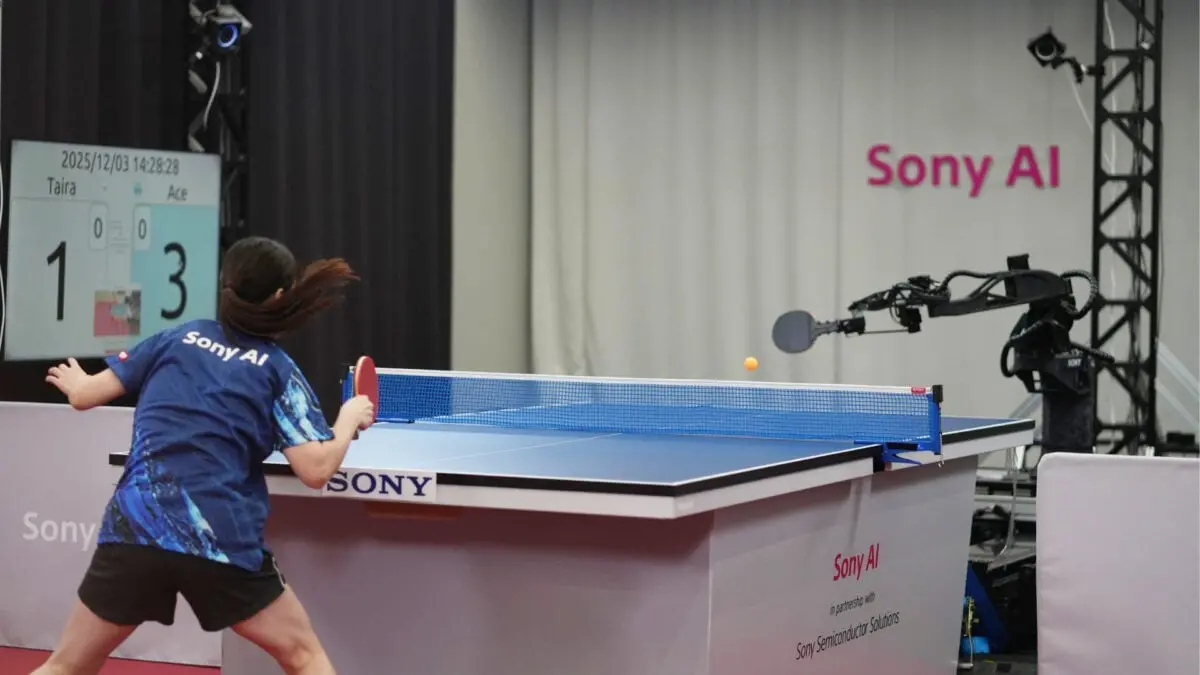
An Unlikely Champion Emerges: Sony’s Robot Ace Takes on Table Tennis Pros
The world of competitive table tennis has a new contender—and it doesn’t have a heartbeat. Sony’s AI division has unveiled a robotic system named Ace that can consistently beat elite human players and even hold its own against seasoned professionals. The research, published in the journal Nature, marks a significant leap in the field of physical artificial intelligence, where robots must sense, decide, and act in real time under imperfect conditions.
Lead author Peter Dürr of Sony AI said the project was designed to push the boundaries of what AI can achieve in the physical world. “Unlike simulated environments where AI can rely on perfect information, real-world sports like table tennis demand rapid decision-making based on state estimation from noisy sensors and adversarial human interactions,” he explained.
What Makes Ace Different?
Robots have played table tennis before, dating back to the 1980s. But Ace stands out because it was tested under official International Table Tennis Federation (ITTF) rules with licensed umpires. The robot uses a combination of high-speed cameras, radar sensors, and a custom AI model trained through reinforcement learning to anticipate ball trajectory, spin, and placement. It can generate high-spin shots that force opponents into difficult returns.
In trials conducted in April 2025, Ace faced five elite players—humans with over a decade of experience and at least 20 hours of weekly training. Ace won three out of five matches. It also played against two professionals active in Japan’s top league: Minami Ando and Kakeru Sone. While it lost both official matches, it managed to win one game against Ando. The robot’s agility and consistency at returning fast, spinning balls impressed researchers and players alike.
But the real progress came in later matches. By December 2025, Ace had improved its performance, beating both elite and some professional players. In March 2026, it scored victories against three professionals, including Miyuu Kihara, who at the time was ranked in the top 25 of the World Table Tennis women’s singles. Dürr noted that the robot had become more aggressive, shooting balls closer to the table edges and at greater speeds.
The Technology Behind the Table Tennis Talent
The Ace robot is a far cry from the primitive mechanical arms of early experiments. Its hardware includes a seven-axis robotic arm mounted on a mobile base, capable of rapid angular accelerations. The AI brain uses a deep neural network that fuses data from multiple sensors to predict the ball’s trajectory, spin, and bounce within milliseconds. A second neural network decides the optimal swing angle, speed, and racket orientation. All computations happen in less than 100 milliseconds, allowing Ace to react to serves exceeding 30 miles per hour.
Training Ace was itself a massive undertaking. Sony AI used simulation environments to run millions of practice rallies, gradually shifting to real-world training. The robot learned not only how to return shots but also how to adapt to the style of each opponent—a key skill in a game where anticipation and deception matter as much as speed.
The research team emphasized that Ace’s success is not just about table tennis. The same principles of real-time perception, control, and decision-making could be applied to other domains where humans and robots must interact safely and efficiently. Potential applications include industrial robots that work alongside humans in factories, assistive robots for elderly care, and even autonomous vehicles navigating chaotic environments.
Implications for Robotics and Safety
One of the most challenging aspects of creating Ace was ensuring it could operate without endangering its human opponents. Table tennis involves rapid, powerful movements, and a poorly controlled robot could cause injury. The team developed safety protocols that included limiting the robot’s maximum swing speed and force, as well as emergency stop features triggered by proximity sensors. These safety mechanisms are critical for any future deployment of physical AI in public spaces.
“Sony AI conducted this research to study how AI could operate safely and effectively in the physical world,” said Dürr. “The results highlight the potential of physical AI agents to perform complex, real-time interactive tasks, suggesting broader applications in domains requiring fast, precise human-robot interaction.”
Experts outside Sony have praised the work for its rigorous testing and transparent methodology. Unlike earlier robot demonstrations that cherry-picked easy opponents or simplified rules, Ace’s matches were full-fledged competitions. The robot did not always win—it lost to top pros—but its consistent improvement over time points to a trajectory where robots could eventually challenge even the best human players.
Historical Context: From Pong to Ping-Pong
Table tennis has long been a benchmark for robotics research. As far back as the 1980s, researchers at MIT built a simple robot that could return a ball rolling down a ramp. In the 2000s, the development of high-speed cameras and faster processors enabled robots like the one from Zhejiang University to rally with humans. But none had gone as far as Ace in winning official matches against certified professionals.
The progress mirrors achievements in other AI domains. DeepMind’s AlphaGo defeated the world champion in Go in 2016, but Go is a turn-based game with perfect information. Physical sports introduce chaos: variable lighting, ball wear, player fatigue, and unpredictable spins. Ace’s ability to handle such variability is a testament to advances in both AI hardware and reinforcement learning algorithms.
It also highlights a shift toward embodied AI—systems that learn through interaction with the physical world. Tech giants like OpenAI, Google, and Tesla invest heavily in this area, with the ultimate goal of creating general-purpose robots that can perform a wide range of tasks. Sony’s results suggest that specialized robots can already master human-level physical tasks.
What’s Next for Ace?
The research team plans to continue improving Ace, focusing on consistency against the top tier of professional players. They also intend to explore transfer learning—using the skills Ace developed to help other robots learn tasks like cooking, cleaning, or surgical assistance.
“The project was devised as a way for us to push the individual technologies driving Ace as far as they could,” Dürr said. “The lessons learned might allow scientists to create better robotic systems for various applications across sports, entertainment, and other safety-critical physical domains.”
For table tennis fans, the rise of Ace is both exciting and humbling. The robot’s ability to serve and return high-speed, high-spin balls is a reminder of how far AI has come. And for those who struggle with the game, as I do, there is a strange comfort in knowing that a machine can now do what we could not—ace the competition.
Source: Gizmodo News